Operational Excellence Agility and Continuous Improvement are part of Human Behavior
In developing the Operational Excellence Agility™ Model, I reflected on over 25 years of manufacturing experience detailed in my daily journal. My journal recorded both outstanding team contributions and personal opportunities for improvement in three key areas: operational excellence, people & culture, and leadership. Many industries are fraught with operational challenges, provided the opportunity for continuous improvement. In my experience, continuous improvement was periodically discussed as a key program tool, but the activity would start strong and fade away back to other priorities. This reinforced my belief that Operational Excellence Agility and continuous improvement can use Artificial Intelligency (AI) to sustain the performance of a continuous improvement program.
Operational Excellence extends beyond the confines of any specific industry. Whether it’s managing patient processes in healthcare, overseeing project management in commercial construction, or any task requiring structured procedures, the principles of operational excellence apply universally. Activities may result in three types of outcomes: proven efficiencies, areas needing improvement, or processes that are so ad-hoc they can be described as “winging it.” Through my experience, I have understood that operational excellence is a systematic process driven by a continuous improvement mindset, aimed at enhancing organizational performance across all facets, including customer satisfaction.
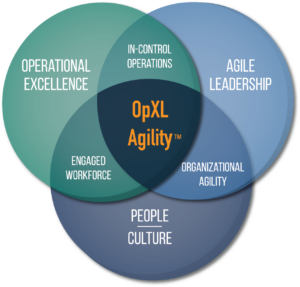
Achieving Operational Excellence Agility™ requires balancing three major organizational components: operational excellence, people and culture, and agile leadership. Without this balance, companies cannot reach their full potential or outperform their competition. Typically, organizations excel in one or two of these areas but rarely in all three. Embracing agility in these components fosters a mindset prepared to navigate a volatile, uncertain, complex, and ambiguous (VUCA) world, ready for the next disruption.
Operational Excellence combines operations, knowledge, and experience to drive change in the process to achieve safe, reliable, and efficient outputs.
Agile Leadership is the ability to glean insights from the data, engage the team, and take action to improve the outcomes.
People and Culture is building a collaborative team that knows their strengths and weaknesses with a bias to deliver even higher results.
Artificial Intelligence (AI) has become a pivotal tool in driving and sustaining continuous improvement across various industries. By leveraging advanced data analytics, machine learning, and automation, AI can significantly enhance the process of continuous improvement, making it more effective and ingrained in organizational behavior. Here are several ways AI supports continuous improvement:
1. Data Analysis and Insights
AI excels at processing vast amounts of data quickly and accurately. It can identify patterns, trends, and anomalies that might be missed by human analysis. This capability allows organizations to gain deeper insights into their operations, identifying areas for improvement and efficiency gains. By continuously monitoring and analyzing data, AI ensures that the process of improvement is ongoing and based on real-time information.
Predictive Maintenance: AI can predict equipment failures before they occur, allowing for proactive maintenance and reducing downtime.
Customer Feedback Analysis: AI can analyze customer feedback from multiple sources, providing insights into customer satisfaction and areas needing improvement.
2. Process Automation
AI can automate routine and repetitive tasks, freeing up human resources to focus on more strategic activities. Automation ensures that processes are performed consistently and efficiently, reducing errors and improving overall quality.
Automated Reporting: AI generates reports and dashboards, providing real-time insights and reducing the manual effort required for data compilation.
Robotic Process Automation (RPA): AI-powered robots can handle tasks such as data entry, processing transactions, and managing workflows.
3. Enhanced Decision Making
AI provides decision-makers with actionable insights, enabling them to make informed decisions quickly. By leveraging AI’s analytical capabilities, organizations can enhance their problem-solving processes and implement more effective improvement strategies.
Decision Support Systems: AI systems can simulate various scenarios and predict outcomes, helping leaders choose the best course of action.
Optimization Algorithms: AI can optimize resource allocation, production schedules, and supply chain processes, leading to continuous improvement in efficiency and cost savings.
4. Real-Time Monitoring and Feedback
AI enables real-time monitoring of operations and provides instant feedback on performance. This immediate feedback loop is crucial for continuous improvement, as it allows for quick adjustments and iterative improvements.
Quality Control: AI-powered vision systems can inspect products in real-time, ensuring quality standards are met and identifying defects early in the process.
Performance Dashboards: AI-driven dashboards provide real-time visibility into key performance metrics, allowing teams to monitor progress and address issues promptly.
5. Personalized Learning and Development
AI can tailor training and development programs to individual needs, ensuring that employees acquire the skills necessary for continuous improvement. Personalized learning pathways enhance employee performance and foster a culture of continuous improvement.
Adaptive Learning Systems: AI-based platforms can adjust training content based on an employee’s learning style and progress.
Skill Gap Analysis: AI can identify skill gaps within the workforce and recommend targeted training programs to address these gaps.
Conclusion AI plays a crucial role in supporting and sustaining continuous improvement by providing advanced data analysis, automating processes, enhancing decision-making, enabling real-time monitoring, and personalizing learning and development. By incorporating AI into continuous improvement initiatives, organizations can ensure that these efforts are effective, sustainable, and deeply embedded into their culture and day-to-day operations. This integration fosters an environment where continuous improvement becomes a natural and automatic response to challenges and opportunities, driving ongoing success and innovation.
* Palmetto Premier Consulting LLC, based in Charleston, SC, is an operations, leadership, and development consulting agency. Specializing in Operational Excellence Agility™, they support teams to cultivate a fast, flexible mindset, emphasizing systematic operations and continuous improvement as a human behavior strength. Palmetto Premier Consulting LLC tailors their four-step success program, encompassing assessment, recommendation, implementation, and verification, to align with your company’s specific objectives.